Book Catalog
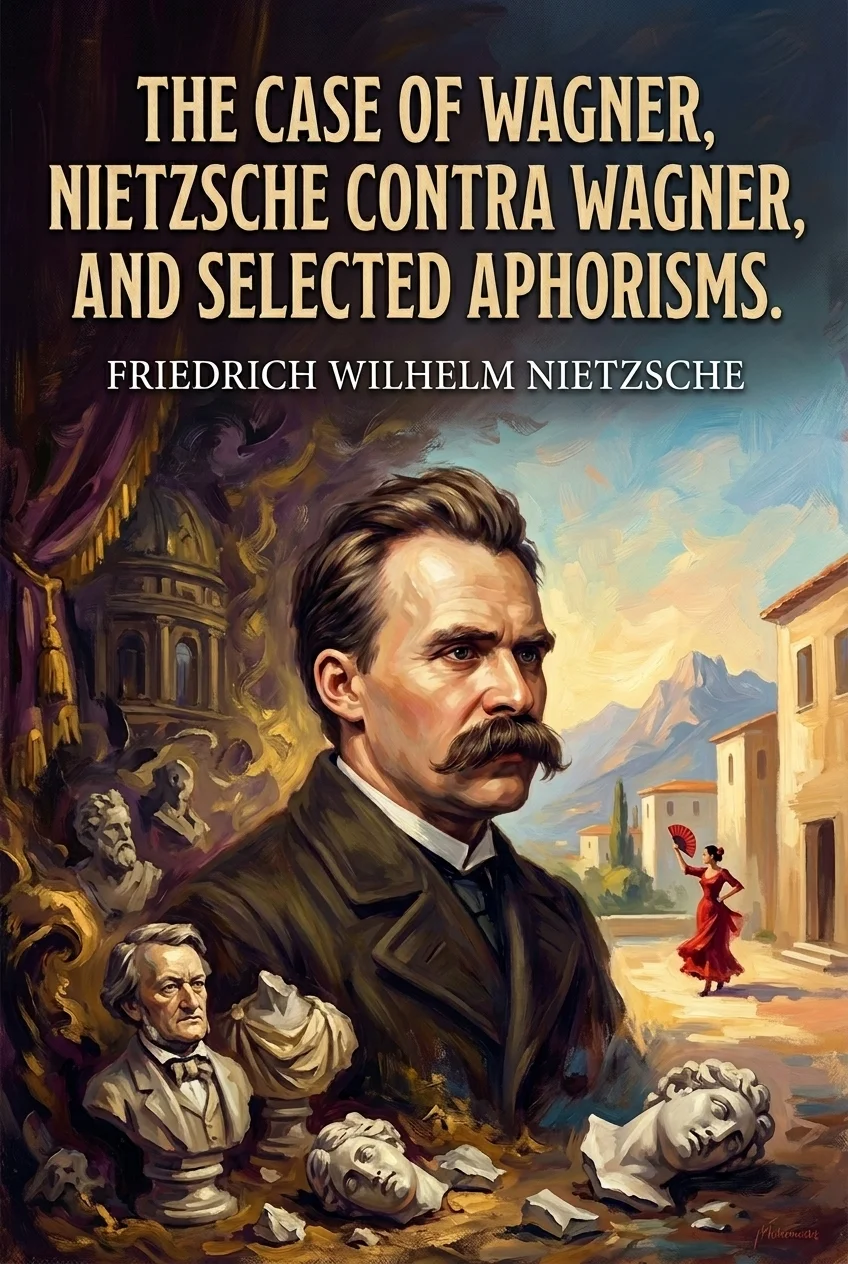
The Case Of Wagner, Nietzsche Contra Wagner, and Selected Aphorisms.

The Case Of Wagner, Nietzsche Contra Wagner, and Selected Aphorisms.

Friedrich Wilhelm Nietzsche

Friedrich Nietzsche’s explosive work confronts the cultural pathology of modern Europe through his dramatic break with Richard Wagner. Contrasting Wagner’s heavy, theatrical decadence with the sunny clarity of Bizet’s Carmen, Nietzsche exposes how art acts as a biological symptom of either decline or vitality. Written with biting irony and profound psychological insight, this book challenges philosophers, musicologists, and truth-seekers to overcome their own intellectual idols.

Genre: Philosophy, Non-Fiction
Language: English
Format: eBook, WebBook

Start Reading

Sign up for free to access this book.

Sign Up to Read

About the Author

Friedrich Wilhelm Nietzsche

Friedrich Wilhelm Nietzsche

1844 - 1900

Friedrich Wilhelm Nietzsche (b. 1844) was a German philosopher, cultural critic, and classical philologist whose work profoundly challenged the foundations of Western philosophy and Christian morality. He is widely recognized for his critique of traditional European values, his radical perspectives on truth, and his concepts of the Ubermensch and the will to power. His provocative ideas on aesthetics and existentialism left an indelible mark on modern intellectual history.

Born in Röcken, Germany, Nietzsche demonstrated exceptional academic talent early in life, becoming a professor of classical philology at the University of Basel in 1869 at the age of twenty-four. During his tenure, he developed a close friendship with the composer Richard Wagner, though their relationship later dissolved due to deep ideological differences. Chronic health problems forced Nietzsche to retire from teaching in 1879, initiating a decade of nomadic writing across Switzerland, Italy, and France.

This period of isolation proved to be his most productive, during which he formulated his critique of Christian dogma and explored the psychological motivations behind human belief systems. His philosophical journey ended abruptly in 1889 when he suffered a severe mental collapse in Turin, Italy, leaving him incapacitated until his death in Weimar in 1900. Despite his struggles, his writings went on to exert a monumental influence on twentieth-century literature, psychology, and philosophy.

Essential Reading:

  • The Dawn of Day (1881): This work represents a crucial transition in the author's philosophy, offering a series of insightful thoughts on the origins of moral prejudices.
  • The Case Of Wagner (1888): A brilliant and biting critique of his former friend Richard Wagner, analyzing the composer's music as a symptom of cultural decay.
  • Nietzsche Contra Wagner (1889): A compiled selection of essays clarifying his final break with Wagner and defending his own philosophical independence.
  • The Antichrist (1895): A fierce and controversial polemic that attacks institutional Christianity and its historical impact on Western values.
  • Selected Aphorisms (1999): A curated collection of the philosopher's sharpest, most provocative short insights on morality, art, and human nature.
Read more about the author

More in Philosophy

Top Read This Month

Top Read All Time