I
The crisis came about a week from that time—I say about because of Melville's conscientious inexactness in these matters. And so far as the crisis goes, I seem to get Melville at his best. He was keenly interested, keenly observant, and his more than average memory took some excellent impressions. To my mind, at any rate, two at least of these people come out, fuller and more convincingly than anywhere else in this painfully disinterred story. He has given me here an Adeline I seem to believe in, and something much more like Chatteris than any of the broken fragments I have had to go upon, and amplify and fudge together so far. And for all such transient lucidities in this mysterious story, the reader no doubt will echo my Heaven be thanked!
Melville was called down to participate in the crisis at Sandgate by a telegram from Mrs. Bunting, and his first exponent of the situation was Fred Bunting.
"Come down. Urgent. Please," was the irresistible message from Mrs. Bunting. My cousin took the early train and arrived at Sandgate in the forenoon.
He was told that Mrs. Bunting was upstairs with Miss Glendower and that she implored him to wait until she could leave her charge. "Miss Glendower not well, then?" said Melville. "No, sir, not at all well," said the housemaid, evidently awaiting a further question. "Where are the others?" he asked casually. The three younger young ladies had gone to Hythe, said the housemaid, with a marked omission of the Sea Lady. Melville has an intense dislike of questioning servants on points at issue, so he asked nothing at all concerning Miss Waters. This general absence of people from the room of familiar occupation conveyed the same suggested warning of crisis as the telegram. The housemaid waited an instant longer and withdrew.
He stood for a moment in the drawing–room and then walked out upon the veranda. He perceived a richly caparisoned figure advancing towards him. It was Fred Bunting. He had been taking advantage of the general desertion of home to bathe from the house. He was wearing an umbrageous white cotton hat and a striped blanket, and a more aggressively manly pipe than any fully adult male would ever dream of smoking, hung from the corner of his mouth.
"Hello!" he said. "The mater sent for you?"
Melville admitted the truth of this theory.
"There's ructions," said Fred, and removed the pipe. The act offered conversation.
"Where's Miss Waters?"
"Gone."
"Back?"
"Lord, no! Catch her! She's gone to Lummidge's Hotel. With her maid. Took a suite."
"Why―"
"The mater made a row with her."
"Whatever for?"
"Harry."
My cousin stared at the situation.
"It broke out," said Fred.
"What broke out?"
"The row. Harry's gone daft on her, Addy says."
"On Miss Waters?"
"Rather. Mooney. Didn't care for his electioneering—didn't care for his ordinary nourishment. Loose ends. Didn't mention it to Adeline, but she began to see it. Asked questions. Next day, went off. London. She asked what was up. Three days' silence. Then—wrote to her."
Fred intensified all this by raising his eyebrows, pulling down the corners of his mouth and nodding portentously. "Eh?" he said, and then to make things clearer: "Wrote a letter."
"He didn't write to her about Miss Waters?"
"Don't know what he wrote about. Don't suppose he mentioned her name, but I dare say he made it clear enough. All I know is that everything in the house felt like elastic pulled tighter than it ought to be for two whole days—everybody in a sort of complicated twist—and then there was a snap. All that time Addy was writing letters to him and tearing 'em up, and no one could quite make it out. Everyone looked blue except the Sea Lady. She kept her own lovely pink. And at the end of that time the mater began asking things, Adeline chucked writing, gave the mater half a hint, mater took it all in in an instant and the thing burst."
"Miss Glendower didn't―?"
"No, the mater did. Put it pretty straight too—as the mater can…. She didn't deny it. Said she couldn't help herself, and that he was as much hers as Adeline's. I heard that," said Fred shamelessly. "Pretty thick, eh?—considering he's engaged. And the mater gave it her pretty straight. Said, 'I've been very much deceived in you, Miss Waters—very much indeed.' I heard her…."
"And then?"
"Asked her to go. Said she'd requited us ill for taking her up when nobody but a fisherman would have looked at her."
"She said that?".
"Well, words to that effect."
"And Miss Waters went?"
"In a first–class cab, maid and boxes in another, all complete. Perfect lady…. Couldn't have believed if I hadn't seen it—the tail, I mean."
"And Miss Glendower?"
"Addy? Oh, she's been going it. Comes downstairs and does the pale–faced heroine and goes upstairs and does the broken–hearted part. I know. It's all very well. You never had sisters. You know―"
Fred held his pipe elaborately out of the way and protruded his face to a confidential nearness.
"I believe they half like it," said Fred, in a confidential half whisper. "Such a go, you know. Mabel pretty near as bad. And the girls. All making the very most they can of it. Me! I think Chatteris was the only man alive to hear 'em. I couldn't get up emotion as they do, if my feet were being flayed. Cheerful home, eh? For holidays."
"Where's—the principal gentleman?" asked Melville a little grimly. "In London?"
"Unprincipled gentleman, I call him," said Fred. "He's stopping down here at the Métropole. Stuck."
"Down here? Stuck?"
"Rather. Stuck and set about."
My cousin tried for sidelights. "What's his attitude?" he asked.
"Slump," said Fred with intensity.
"This little blow–off has rather astonished him," he explained. "When he wrote to say that the election didn't interest him for a bit, but he hoped to pull around―"
"You said you didn't know what he wrote."
"I do that much," said Fred. "He no more thought they'd have spotted that it meant Miss Waters than a baby. But women are so thundering sharp, you know. They're born spotters. How it'll all end―"
"But why has he come to the Métropole?"
"Middle of the stage, I suppose," said Fred.
"What's his attitude?"
"Says he's going to see Adeline and explain everything—and doesn't do it…. Puts it off. And Adeline, as far as I can gather, says that if he doesn't come down soon, she's hanged if she'll see him, much as her heart may be broken, and all that, if she doesn't. You know."
"Naturally," said Melville, rather inconsecutively. "And he doesn't?"
"Doesn't stir."
"Does he see—the other lady?"
"We don't know. We can't watch him. But if he does he's clever―"
"Why?"
"There's about a hundred blessed relatives of his in the place—came like crows for a corpse. I never saw such a lot. Talk about a man of good old family—it's decaying! I never saw such a high old family in my life. Aunts they are chiefly."
"Aunts?"
"Aunts. Say, they've rallied round him. How they got hold of it I don't know. Like vultures. Unless the mater— But they're here. They're all at him—using their influence with him, threatening to cut off legacies and all that. There's one old girl at Bate's, Lady Poynting Mallow—least bit horsey, but about as all right as any of 'em—who's been down here twice. Seems a trifle disappointed in Adeline. And there's two aunts at Wampach's—you know the sort that stop at Wampach's—regular hothouse flowers—a watering–potful of real icy cold water would kill both of 'em. And there's one come over from the Continent, short hair, short skirts—regular terror—she's at the Pavilion. They're all chasing round saying, 'Where is this woman–fish sort of thing? Let me peek!'"
"Does that constitute the hundred relatives?"
"Practically. The Wampachers are sending for a Bishop who used to be his schoolmaster―"
"No stone unturned, eh?"
"None."
"And has he found out yet―"
"That she's a mermaid? I don't believe he has. The pater went up to tell him. Of course, he was a bit out of breath and embarrassed. And Chatteris cut him down. 'At least let me hear nothing against her,' he said. And the pater took that and came away. Good old pater. Eh?"
"And the aunts?"
"They're taking it in. Mainly they grasp the fact that he's going to jilt Adeline, just as he jilted the American girl. The mermaid side they seem to boggle at. Old people like that don't take to a new idea all at once. The Wampach ones are shocked—but curious. They don't believe for a moment she really is a mermaid, but they want to know all about it. And the one down at the Pavilion simply said, 'Bosh! How can she breathe under water? Tell me that, Mrs. Bunting. She's some sort of person you have picked up, I don't know how, but mermaid she cannot be.' They'd be all tremendously down on the mater, I think, for picking her up, if it wasn't that they can't do without her help to bring Addy round again. Pretty mess all round, eh?"
"I suppose the aunts will tell him?"
"What?"
"About the tail."
"I suppose they will."
"And what then?"
"Heaven knows! Just as likely they won't."
My cousin meditated on the veranda tiles for a space.
"It amuses me," said Fred Bunting.
"Look here," said my cousin Melville, "what am I supposed to do? Why have I been asked to come?"
"I don't know. Stir it up a bit, I expect. Everybody do a bit—like the Christmas pudding."
"But—" said Melville.
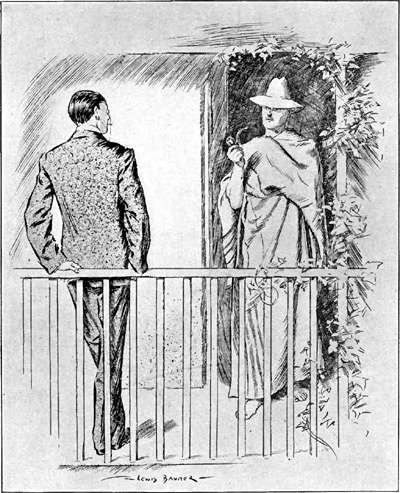
Adjusting the folds of his blanket to a greater dignity.
"I've been bathing," said Fred. "Nobody asked me to take a hand and I didn't. It won't be a good pudding without me, but there you are! There's only one thing I can see to do―"
"It might be the right thing. What is it?"
"Punch Chatteris's head."
"I don't see how that would help matters."
"Oh, it wouldn't help matters," said Fred, adding with an air of conclusiveness, "There it is!" Then adjusting the folds of his blanket to a greater dignity, and replacing his long extinct large pipe between his teeth, he went on his way. The tail of his blanket followed him reluctantly through the door. His bare feet padded across the hall and became inaudible on the carpet of the stairs.
"Fred!" said Melville, going doorward with a sudden afterthought for fuller particulars.
But Fred had gone.
Instead, Mrs. Bunting appeared.