V
To add to Melville's distress, as petty discomforts do add to all genuine trouble, his club–house was undergoing an operation, and was full of builders and decorators; they had gouged out its windows and gagged its hall with scaffolding, and he and his like were guests of a stranger club that had several members who blew. They seemed never to do anything but blow and sigh and rustle papers and go to sleep about the place; they were like blight–spots on the handsome plant of this host–club, and it counted for little with Melville, in the state he was in, that all the fidgety breathers were persons of eminent position. But it was this temporary dislocation of his world that brought him unexpectedly into a quasi confidential talk with Chatteris one afternoon, for Chatteris was one of the less eminent and amorphous members of this club that was sheltering Melville's club.
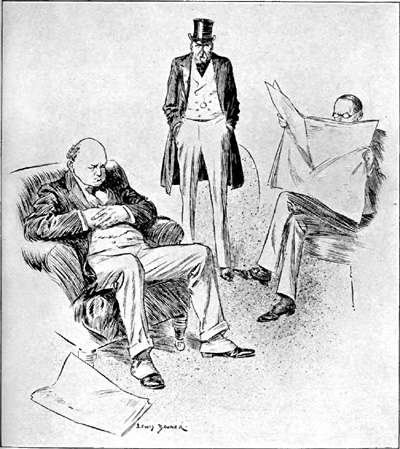
They seemed never to do anything but blow and sigh and rustle papers.
Melville had taken up Punch—he was in that mood when a man takes up anything—and was reading, he did not know exactly what. Presently he sighed, looked up, and discovered Chatteris entering the room.
He was surprised to see Chatteris, startled and just faintly alarmed, and Chatteris it was evident was surprised and disconcerted to see him. Chatteris stood in as awkward an attitude as he was capable of, staring unfavourably, and for a moment or so he gave no sign of recognition. Then he nodded and came forward reluctantly. His every movement suggested the will without the wit to escape. "You here?" he said.
"What are you doing away from Hythe at this time?" asked Melville.
"I came here to write a letter," said Chatteris.
He looked about him rather helplessly. Then he sat down beside Melville and demanded a cigarette. Suddenly he plunged into intimacy.
"It is doubtful whether I shall contest Hythe," he remarked.
"Yes?"
"Yes."
He lit his cigarette.
"Would you?" he asked.
"Not a bit of it," said Melville. "But then it's not my line."
"Is it mine?"
"Isn't it a little late in the day to drop it?" said Melville. "You've been put up for it now. Every one's at work. Miss Glendower―"
"I know," said Chatteris.
"Well?"
"I don't seem to want to go on."
"My dear man!"
"It's a bit of overwork perhaps. I'm off colour. Things have gone flat. That's why I'm up here."
He did a very absurd thing. He threw away a quarter–smoked cigarette and almost immediately demanded another.
"You've been a little immoderate with your statistics," said Melville.
Chatteris said something that struck Melville as having somehow been said before. "Election, progress, good of humanity, public spirit. None of these things interest me really," he said. "At least, not just now."
Melville waited.
"One gets brought up in an atmosphere in which it's always being whispered that one should go for a career. You learn it at your mother's knee. They never give you time to find out what you really want, they keep on shoving you at that. They form your character. They rule your mind. They rush you into it."
"They didn't rush me," said Melville.
"They rushed me, anyhow. And here I am!"
"You don't want a career?"
"Well— Look what it is."
"Oh! if you look at what things are!"
"First of all, the messing about to get into the House. These confounded parties mean nothing—absolutely nothing. They aren't even decent factions. You blither to damned committees of damned tradesmen whose sole idea for this world is to get overpaid for their self–respect; you whisper and hobnob with local solicitors and get yourself seen about with them; you ask about the charities and institutions, and lunch and chatter and chum with every conceivable form of human conceit and pushfulness and trickery―"
He broke off. "It isn't as if they were up to anything! They're working in their way, just as you are working in your way. It's the same game with all of them. They chase a phantom gratification, they toil and quarrel and envy, night and day, in the perpetual attempt to persuade themselves in spite of everything that they are real and a success―"
He stopped and smoked.
Melville was spiteful. "Yes," he admitted, "but I thought your little movement was to be something more than party politics and self–advancement―?"
He left his sentence interrogatively incomplete.
"The condition of the poor," he said.
"Well?" said Chatteris, regarding him with a sort of stony admission in his blue eyes.
Melville dodged the look. "At Sandgate," he said, "there was, you know, a certain atmosphere of belief―"
"I know," said Chatteris for the second time.
"That's the devil of it!" said Chatteris after a pause.
"If I don't believe in the game I'm playing, if I'm left high and dry on this shoal, with the tide of belief gone past me, it isn't my planning, anyhow. I know the decent thing I ought to do. I mean to do it; in the end I mean to do it; I'm talking in this way to relieve my mind. I've started the game and I must see it out; I've put my hand to the plough and I mustn't go back. That's why I came to London—to get it over with myself. It was running up against you, set me off. You caught me at the crisis."
"Ah!" said Melville.
"But for all that, the thing is as I said—none of these things interest me really. It won't alter the fact that I am committed to fight a phantom election about nothing in particular, for a party that's been dead ten years. And if the ghosts win, go into the Parliament as a constituent spectre…. There it is—as a mental phenomenon!"
He reiterated his cardinal article. "The interest is dead," he said, "the will has no soul."
He became more critical. He bent a little closer to Melville's ear. "It isn't really that I don't believe. When I say I don't believe in these things I go too far. I do. I know, the electioneering, the intriguing is a means to an end. There is work to be done, sound work, and important work. Only―"
Melville turned an eye on him over his cigarette end.
Chatteris met it, seemed for a moment to cling to it. He became absurdly confidential. He was evidently in the direst need of a confidential ear.
"I don't want to do it. When I sit down to it, square myself down in the chair, you know, and say, now for the rest of my life this is IT—this is your life, Chatteris; there comes a sort of terror, Melville."
"H'm," said Melville, and turned away. Then he turned on Chatteris with the air of a family physician, and tapped his shoulder three times as he spoke. "You've had too much statistics, Chatteris," he said.
He let that soak in. Then he turned about towards his interlocutor, and toyed with a club ash tray. "It's every day has overtaken you," he said. "You can't see the wood for the trees. You forget the spacious design you are engaged upon, in the heavy details of the moment. You are like a painter who has been working hard upon something very small and exacting in a corner. You want to step back and look at the whole thing."
"No," said Chatteris, "that isn't quite it."
Melville indicated that he knew better.
"I keep on, stepping back and looking at it," said Chatteris. "Just lately I've scarcely done anything else. I'll admit it's a spacious and noble thing—political work done well—only— I admire it, but it doesn't grip my imagination. That's where the trouble comes in."
"What does grip your imagination?" asked Melville. He was absolutely certain the Sea Lady had been talking this paralysis into Chatteris, and he wanted to see just how far she had gone. "For example," he tested, "are there—by any chance—other dreams?"
Chatteris gave no sign at the phrase. Melville dismissed his suspicion. "What do you mean—other dreams?" asked Chatteris.
"Is there conceivably another way—another sort of life—some other aspect―?"
"It's out of the question," said Chatteris. He added, rather remarkably, "Adeline's awfully good."
My cousin Melville acquiesced silently in Adeline's goodness.
"All this, you know, is a mood. My life is made for me—and it's a very good life. It's better than I deserve."
"Heaps," said Melville.
"Much," said Chatteris defiantly.
"Ever so much," endorsed Melville.
"Let's talk of other things," said Chatteris. "It's what even the street boys call mawbid nowadays to doubt for a moment the absolute final all–this–and–nothing–else–in–the–worldishness of whatever you happen to be doing."
My cousin Melville, however, could think of no other sufficiently interesting topic. "You left them all right at Sandgate?" he asked, after a pause.
"Except little Bunting."
"Seedy?"
"Been fishing."
"Of course. Breezes and the spring tides…. And Miss Waters?"
Chatteris shot a suspicious glance at him. He affected the offhand style. "She's quite well," he said. "Looks just as charming as ever."
"She really means that canvassing?"
"She's spoken of it again."
"She'll do a lot for you," said Melville, and left a fine wide pause.
Chatteris assumed the tone of a man who gossips.
"Who is this Miss Waters?" he asked.
"A very charming person," said Melville and said no more.
Chatteris waited and his pretence of airy gossip vanished. He became very much in earnest.
"Look here," he said. "Who is this Miss Waters?"
"How should I know?" prevaricated Melville.
"Well, you do know. And the others know. Who is she?"
Melville met his eyes. "Won't they tell you?" he asked.
"That's just it," said Chatteris.
"Why do you want to know?"
"Why shouldn't I know?"
"There's a sort of promise to keep it dark."
"Keep what dark?"
My cousin gestured.
"It can't be anything wrong?" My cousin made no sign.
"She may have had experiences?"
My cousin reflected a moment on the possibilities of the deep–sea life. "She has had them," he said.
"I don't care, if she has."
There came a pause.
"Look here, Melville," said Chatteris, "I want to know this. Unless it's a thing to be specially kept from me…. I don't like being among a lot of people who treat me as an outsider. What is this something about Miss Waters?"
"What does Miss Glendower say?"
"Vague things. She doesn't like her and she won't say why. And Mrs. Bunting goes about with discretion written all over her. And she herself looks at you— And that maid of hers looks— The thing's worrying me."
"Why don't you ask the lady herself?"
"How can I, till I know what it is? Confound it! I'm asking you plainly enough."
"Well," said Melville, and at the moment he had really decided to tell Chatteris. But he hung upon the manner of presentation. He thought in the moment to say, "The truth is, she is a mermaid." Then as instantly he perceived how incredible this would be. He always suspected Chatteris of a capacity for being continental and romantic. The man might fly out at him for saying such a thing of a lady.
A dreadful doubt fell upon Melville. As you know, he had never seen that tail with his own eyes. In these surroundings there came to him such an incredulity of the Sea Lady as he had not felt even when first Mrs. Bunting told him of her. All about him was an atmosphere of solid reality, such as one can breathe only in a first–class London club. Everywhere ponderous arm–chairs met the eye. There were massive tables in abundance and match–boxes of solid rock. The matches were of some specially large, heavy sort. On a ponderous elephant–legged green baize table near at hand were several copies of the Times, the current Punch, an inkpot of solid brass, and a paper weight of lead. There are other dreams! It seemed impossible. The breathing of an eminent person in a chair in the far corner became very distinct in that interval. It was heavy and resolute like the sound of a stone–mason's saw. It insisted upon itself as the touchstone of reality. It seemed to say that at the first whisper of a thing so utterly improbable as a mermaid it would snort and choke.
"You wouldn't believe me if I told you," said Melville.
"Well, tell me—anyhow."
My cousin looked at an empty chair beside him. It was evidently stuffed with the very best horse–hair that money could procure, stuffed with infinite skill and an almost religious care. It preached in the open invitation of its expanded arms that man does not live by bread alone—inasmuch as afterwards he needs a nap. An utterly dreamless chair!
Mermaids?
He felt that he was after all quite possibly the victim of a foolish delusion, hypnotised by Mrs. Bunting's beliefs. Was there not some more plausible interpretation, some phrase that would lie out bridgeways from the plausible to the truth?
"It's no good," he groaned at last.
Chatteris had been watching him furtively.
"Oh, I don't care a hang," he said, and shied his second cigarette into the massively decorated fireplace. "It's no affair of mine."
Then quite abruptly he sprang to his feet and gesticulated with an ineffectual hand.
"You needn't," he said, and seemed to intend to say many regrettable things. Meanwhile until his intention ripened he sawed the air with his ineffectual hand. I fancy he ended by failing to find a thing sufficiently regrettable to express the pungency of the moment. He flung about and went towards the door.
"Don't!" he said to the back of the newspaper of the breathing member.
"If you don't want to," he said to the respectful waiter at the door.
The hall–porter heard that he didn't care—he was damned if he did!
"He might be one of these here guests," said the hall–porter, greatly shocked. "That's what comes of lettin' 'em in so young."