1899 - 1951
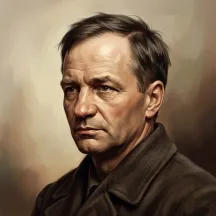
Andrey Platonovich Platonov (1899–1951) was a Soviet Russian novelist, short story writer, poet, and playwright whose distinctive style made him one of the most significant literary figures of the early Soviet era. His prose fused existential philosophy with a unique linguistic voice that captured the complex socio-political transformations of his time. Through his nuanced depictions of Soviet industrialization and collectivization, he created a profound body of work that gained widespread international acclaim after his death.
Born in Voronezh, Russia, Platonov initially trained as an electrical engineer and land reclamation specialist, managing major civil infrastructure projects during the 1920s. His professional technical background heavily influenced his creative output, instilling a fascination with technology, labor, and humanity's physical struggle against harsh natural elements. During the Russian Civil War, he served as a journalist and military correspondent, an experience that deepened his critical observation of revolutionary idealism and human suffering.
Throughout the 1930s, Platonov faced severe political censorship as Soviet authorities criticized his works for political ambiguity, leading to his exclusion from official literary circles. Despite personal tragedy, including the political arrest of his young son, he continued writing while serving as a frontline war correspondent during World War II. He passed away in Moscow in 1951 from tuberculosis, leaving behind an exceptional literary legacy that was fully rediscovered and published decades later.
Essential Reading
- In the Beautiful and Furious World (في العالم الرائع المحتدم): A compelling collection of short stories examining human resilience, technological fascination, and the delicate balance between humanity and nature.
- The Foundation Pit (Котлован): A celebrated dystopian narrative that chronicles the bleak reality and psychological toll of Soviet collectivization through the construction of an endless civic foundation.
- Chevengur (Чевенгур): A landmark philosophical novel describing a group of idealistic villagers who attempt to establish an isolated utopian communist society in provincial Russia.