John Ruskin
1819 – 1900
English
1 bookBiography
John Ruskin (1819) is a British polymath, art critic, and social thinker who profoundly shaped Victorian cultural and aesthetic standards. Through his extensive writings on nature, art, and political economy, he challenged industrial modernity and advocated for the spiritual and moral integrity of craftsmanship.
Born in London to a wealthy sherry merchant and an intensely religious mother, Ruskin received a private education that emphasized literature and the Bible before attending Christ Church, Oxford, where he won the Newdigate Prize for poetry in 1839. His early passion for sketching and geology fueled his groundbreaking defense of J. M. W. Turner, which expanded into the monumental multi-volume art treatise Modern Painters published between 1843 and 1860. Travelling extensively throughout Europe, he developed a deep fascination with Gothic architecture and the medieval past, leading to his influential cultural critiques in the mid-nineteenth century.
In the 1860s, Ruskin transitioned from art criticism to social and economic reform, fiercely criticizing laissez-faire capitalism and industrial labor conditions in essays such as Unto This Last. Appointed as the first Slade Professor of Fine Art at the University of Oxford in 1869, he lectured widely and established the Guild of St. George to promote traditional labor, education, and ecological preservation. His dynamic synthesis of aesthetic beauty and social justice left an enduring legacy on modern labor movements, environmentalism, and urban planning.
Essential Reading
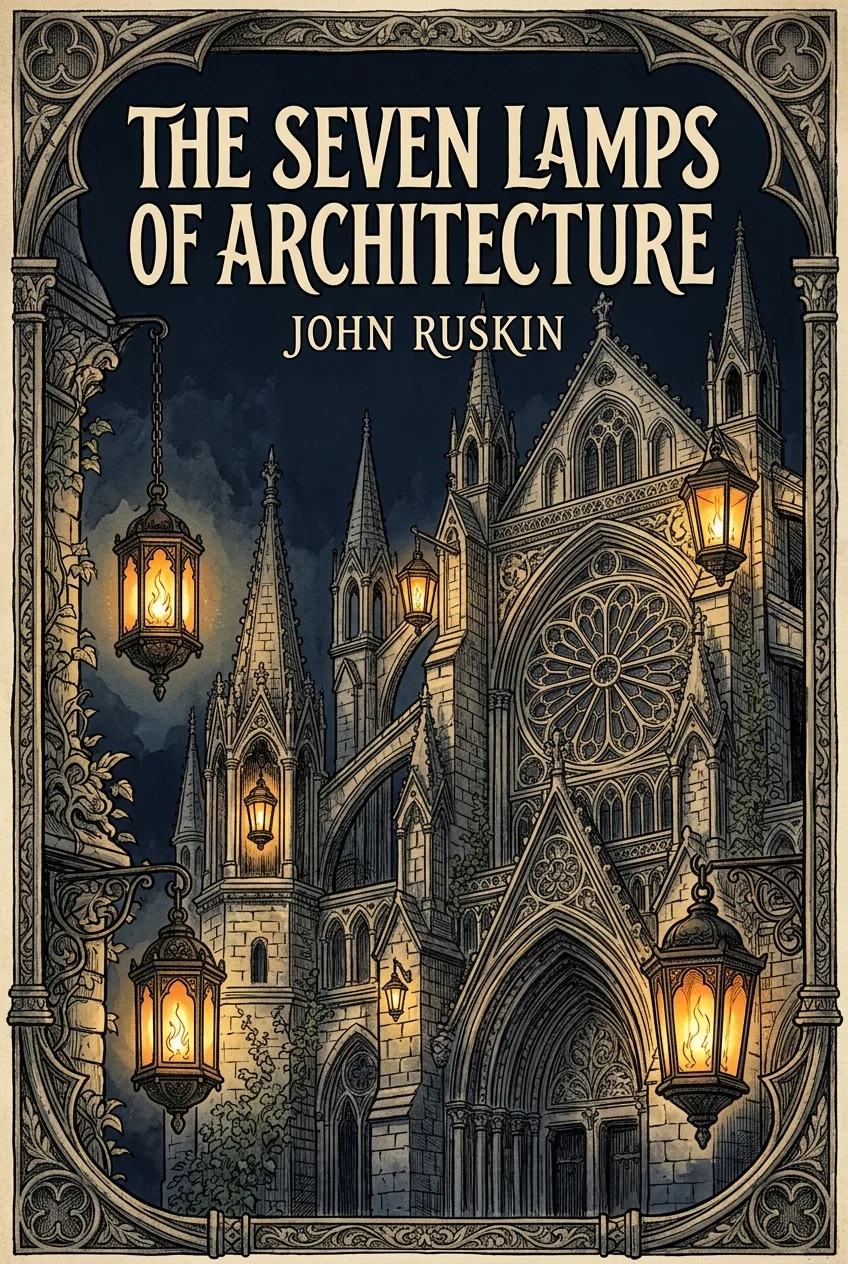
- The Seven Lamps of Architecture (1849): This foundational treatise examines the moral and spiritual principles of building, identifying sacrifice, truth, power, beauty, life, memory, and obedience as the essential virtues of great architecture.
- Modern Painters (1843): This expansive five-volume work defends modern landscape art while arguing that true artistic greatness depends on an artist's faithful and loving observation of nature.
- The Stones of Venice (1851): This architectural study uses the Gothic buildings of Venice to critique the dehumanizing effects of the Industrial Revolution on modern labor and societal values.
- Unto This Last (1862): This radical critique of classical political economy redefines wealth through human welfare and social affection rather than mere material accumulation.