Hercule-Savinien Cyrano de Bergerac
1619 – 1655
French
1 bookBiography
Hercule-Savinien de Cyrano de Bergerac (1619-1655) was a French writer, poet, and free-thinker of the seventeenth century. Often associated with the romanticized figure of the big-nosed swordsman, he was above all an author of remarkable intellectual audacity, considered one of the precursors of modern science fiction. His writings blend skeptical philosophy, social satire, and scientific imagination, profoundly marking the history of libertine literature.
Born in Paris, he spent part of his youth on the family estate of Bergerac, in the Paris region, before embarking on a military career within the French Guards corps. He distinguished himself by his courage during the sieges of Mouzon in 1639 and Arras in 1640, where he received serious injuries that forced him to abandon arms. This transition led him to devote himself fully to letters and philosophy, attending the teachings of the materialist scholar Pierre Gassendi.
During this period of intellectual effervescence, Cyrano frequented Parisian libertine circles and fiercely opposed the religious and political dogmas of his time, notably through his Mazarinades. His war experiences and philosophical training nourished a body of work marked by skepticism, the questioning of anthropocentrism, and a fascination for the cosmic infinite. He died prematurely in 1655 in Sannois, from injuries sustained the previous year when a beam fell on him.
Essential Readings
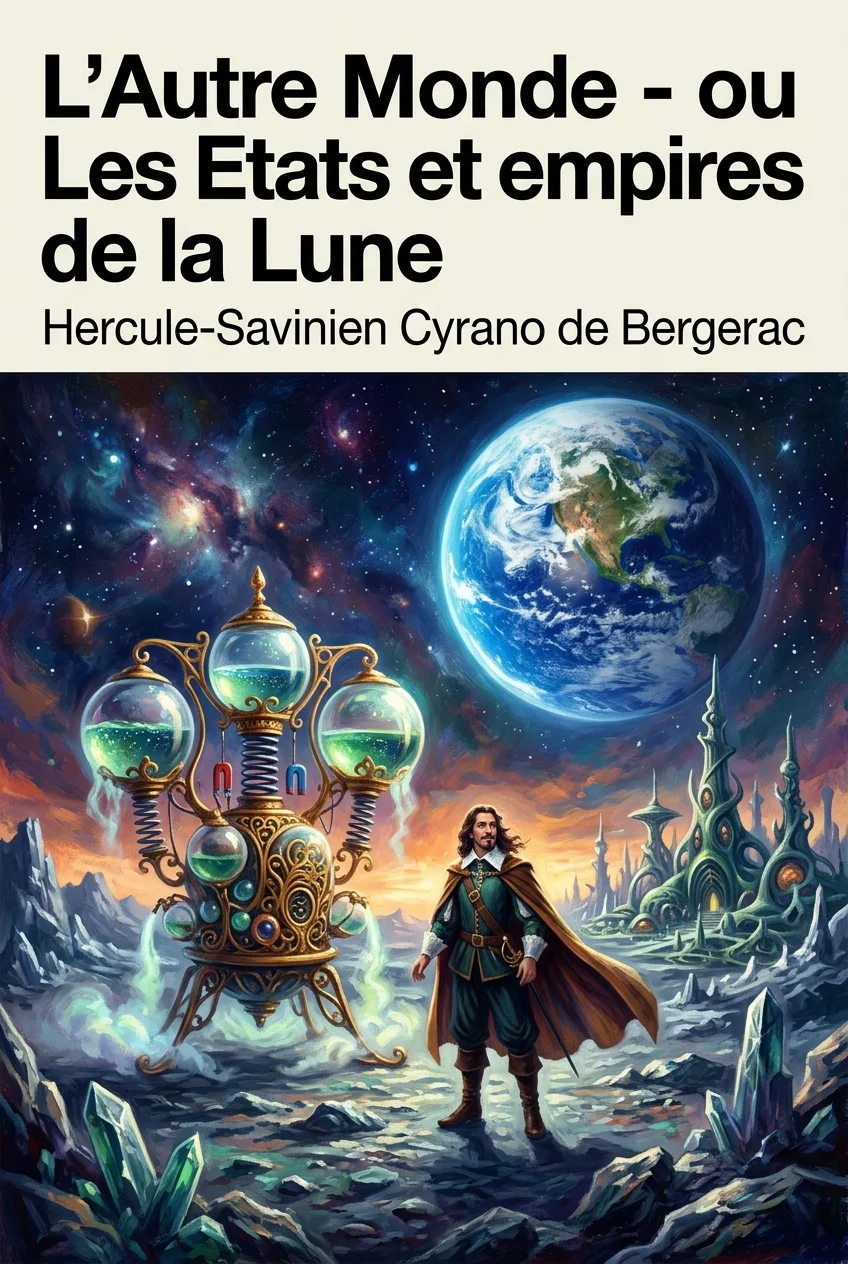
- The Other World - or The States and Empires of the Moon (1657): This imaginary and philosophical travelogue uses the pretext of a flight to the Moon to satirically criticize the society, religion, and scientific certainties of seventeenth-century Europe.
- The States and Empires of the Sun (1662): A direct sequel to his lunar journey, this work continues the exploration of an inhabited cosmos to propose a philosophical and materialist utopia of great modernity.
- The Death of Agrippina (1654): This provocative tragedy caused a scandal upon its creation due to its tirades deemed atheistic and its audacious treatment of Roman political power.