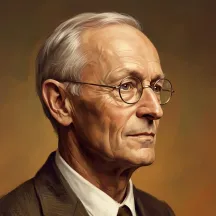
Hermann Hesse
1877 – 1962
German
1 bookBiography
Hermann Hesse (b. 1877) was a German-born Swiss poet, novelist, and painter whose profound explorations of spirituality, self-discovery, and the duality of human nature made him one of the most influential writers of the twentieth century. He received the Nobel Prize in Literature in 1946 for his inspired writings, which grew in boldness and fruitfulness while providing classic ideals of humanitarianism and high stylistic presentation.
Born in Calw, Württemberg, Germany, Hesse grew up in a pietistic missionary family that deeply influenced his early spiritual struggles and rebellious temperament. He ran away from the Maulbronn seminary in 1892 and subsequently worked in various bookstores and machine shops before dedicating himself entirely to writing. His early novels, such as Peter Camenzind, established his literary reputation and allowed him to pursue a full-time career as an author.
The outbreak of World War I deeply affected Hesse, turning him into a vocal pacifist who criticized German nationalism and relocated permanently to Switzerland, where he became a Swiss citizen in 1923. During the 1920s, he underwent psychoanalysis with a student of Carl Jung, a transformative experience that profoundly shaped his psychological depth and gave birth to his masterworks exploring the split between the soul and intellect.
Essential Reading
- Siddhartha (1922): This philosophical novel traces the spiritual journey of a young man named Siddhartha during the time of the Gautama Buddha in search of the ultimate meaning of life.
- Steppenwolf (Der Steppenwolf) (1927): This visionary novel explores the deep psychological alienation and duality of a man torn between his human nature and his wolf-like aggression.
- Narcissus and Goldmund (Narziss und Goldmund) (1930): This rich narrative examines the contrasting yet complementary lives of a rigorous medieval scholar and a wandering artist.